
Jaypirca (Pirtobrutinib): The 2036-2041 Generic Opportunity Window
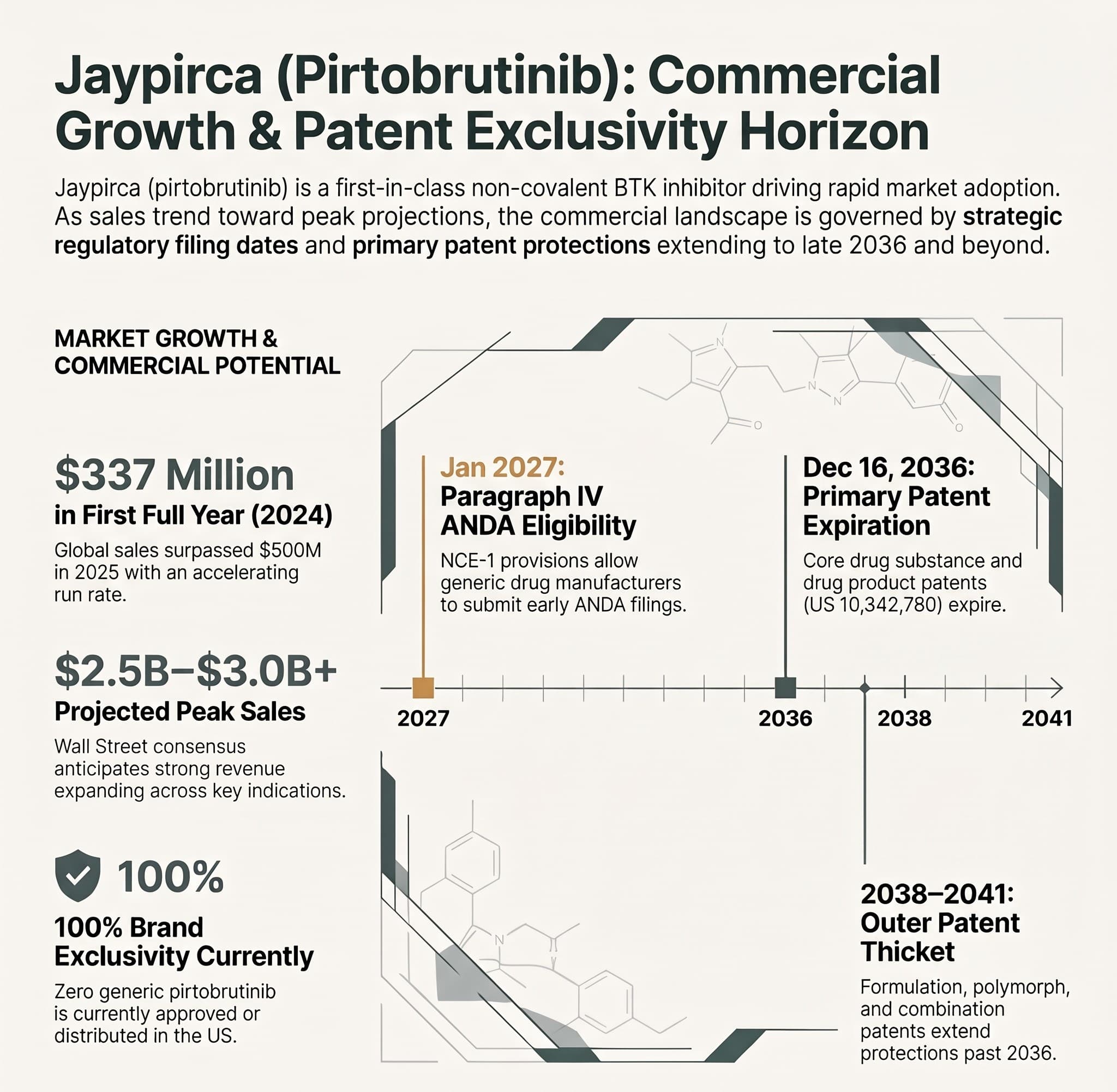
In hematologic oncology, the clinical management of B-cell malignancies has been revolutionized by targeted Bruton's tyrosine kinase (BTK) inhibition. However, the first two generations of BTK inhibitors--covalent agents including ibrutinib, acalabrutinib, and zanubrutinib--share an inherent pharmacological Achilles' heel: they rely upon forming an irreversible covalent bond with cysteine 481 (Cys481) within the kinase ATP-binding pocket. Under prolonged therapeutic selection pressure, malignant clones inevitably develop point mutations at this residue, most notably C481S, C481R, or C481Y, which abolish covalent tethering and trigger disease progression. To overcome this resistance bottleneck, Loxo Oncology (acquired by Eli Lilly and Company) engineered Jaypirca (pirtobrutinib), the first-in-class, highly selective, non-covalent (reversible) BTK inhibitor. Approved under FDA NDA 216059 as 50 mg and 100 mg film-coated tablets for relapsed or refractory mantle cell lymphoma (MCL) and chronic lymphocytic leukemia / small lymphocytic lymphoma (CLL/SLL) following prior covalent BTK therapy, Jaypirca preserves nanomolar inhibitory potency regardless of C481 mutation status while maintaining exceptional selectivity across the kinome. Commercial uptake has surged rapidly, generating $337 million in 2024 global sales and eclipsing a $500 million annualized run rate in 2025, charting a direct trajectory toward peak blockbuster revenues of $2.5 billion to $3.0+ billion USD as frontline combination regimens advance. The molecular architecture of pirtobrutinib demonstrates the elegance of rational, structure-guided kinase inhibitor design. Chemically designated as (S)-5-amino-3-(4-((5-fluoro-2-methoxybenzamido)methyl)phenyl)-1-(1,1,1-trifluoropropan-2-yl)-1H-pyrazole-4-carboxamide, the molecule is built upon a densely substituted pyrazole core. The scaffold incorporates an exocyclic 5-amino substituent and a 4-carboxamide group that engage the kinase hinge region through hydrogen-bonding networks. At N1, the drug carries a chiral (S)-1,1,1-trifluoropropan-2-yl sidechain that projects directly into an induced-fit hydrophobic back pocket, anchoring the molecule through robust van der Waals contacts without requiring covalent engagement with Cys481. Simultaneously, the 3-(4-((5-fluoro-2-methoxybenzamido)methyl)phenyl) substituent extends into the solvent-exposed channel, optimizing pharmacological solubility and pharmacokinetic half-life while delivering greater than 300-fold selectivity against off-target kinases like EGFR, TEC, and ITK. This clean selectivity profile virtually eliminates the troublesome off-target toxicities (such as atrial fibrillation, severe hemorrhage, and hypertension) that frequently force treatment discontinuation with older covalent inhibitors. In the FDA Orange Book, the primary patent perimeter safeguarding Jaypirca is anchored by core chemical substance and pharmaceutical product patents: U.S. Patent No. 10,342,780 (the '780 patent) and U.S. Patent No. 10,464,905 (the '905 patent). Both foundational patents possess a statutory expiration date of December 16, 2036, establishing an uninterrupted exclusivity fortress for the next decade. Method-of-use coverage under U.S. Patent Nos. 10,695,323 and 10,918,622 similarly extends through December 16, 2036. Surrounding this substance core, Lilly has constructed a secondary patent thicket claiming crystalline polymorphic forms, specialized solid oral dosage formulations, and combination treatment regimens (including U.S. Patent Nos. 12,220,401 and 12,268,666) that stretch nominal protection into the 2038 to 2041 window. Today, the commercial market for pirtobrutinib in the United States remains 100 percent brand-only, with zero generic versions approved or commercially distributed. However, under Hatch-Waxman statutory timing, Jaypirca's 5-year New Chemical Entity (NCE) exclusivity expires on January 27, 2028, unlocking the critical NCE-1 Paragraph IV filing window on January 27, 2027. Leading Indian and global generic development powerhouses--including Natco Pharma, Dr. Reddy's Laboratories, Sun Pharma, MSN Laboratories, Cipla, and Hetero Labs--are actively mobilizing API process synthesis teams, focusing on the challenging stereoselective synthesis of the chiral trifluoroisopropyl building block and scalable crystallization protocols. The decade-long window between now and the December 2036 substance expiry positions pirtobrutinib as one of the most commercially attractive oncology targets in modern generic development. SCOPE NOTE: This analysis is based strictly on publicly disclosed FDA Orange Book patent listings, approved prescribing information, and corporate SEC financial filings. It reviews public patent expiration dates, chemical structures, and statutory regulatory milestones only. No opinion is expressed on unasserted patent claims, potential future Paragraph IV litigation, or confidential commercial settlements.
What we do
We track expirations like this continuously
This is one drug, picked for today's post. A Portfolio Retainer watches an entire portfolio or compound class on an ongoing basis and flags new matching filings as they publish.