
Sun Pharma Invalidated Lilly's Gemcitabine Cancer Patent. The Federal Circuit Held Disclosed Antitumor Utility Triggered Double Patenting.
By Prashant Kotian, PhD Researcher (Chemistry), ICT Mumbai

When an innovative pharmaceutical corporation invents a breakthrough small molecule, patent strategy routinely dictates filing a foundational patent covering the chemical composition of matter alongside its initial therapeutic utility. As the drug approaches clinical validation and regulatory approval, brand lifecycle management teams often construct secondary patent rings claiming specific therapeutic regimens, combination therapies, and specialized indications designed to cascade commercial monopolies years beyond the expiration of the original molecule patent. In Sun Pharmaceutical Industries, Ltd. v. Eli Lilly & Co., the U.S. Court of Appeals for the Federal Circuit established a pivotal boundary for pharmaceutical lifecycle extension under the doctrine of obviousness-type double patenting. By invalidating Eli Lilly's later-expiring method-of-use patent for gemcitabine (Gemzar)--a blockbuster chemotherapy agent generating over $1.7 billion in peak annual sales--the appellate court reaffirmed that innovators cannot harvest an extended commercial monopoly by simply patenting therapeutic applications that were already publicly disclosed to support their original compound monopoly.
From a medicinal chemistry perspective, gemcitabine represents an elegant structural triumph in pyrimidine antimetabolite design. Chemically designated as 2'-deoxy-2',2'-difluorocytidine, the drug is a synthetic nucleoside analog modeled after deoxycytidine. Its architectural hallmark lies at the 2'-position of the ribofuranose pentose ring, where two geminal, highly electronegative fluorine atoms (-CF2-) replace the conventional hydrogen atoms found in native DNA precursors. This geminal difluoro substitution dramatically alters the conformational equilibrium of the furanose ring, forcing a preferential 3'-endo/2'-exo sugar pucker while imparting extreme metabolic resistance to pyrimidine nucleoside phosphorylases. Once transported into rapidly dividing malignant cells via equilibrative nucleoside transporters (hENT1 and hCNT3), gemcitabine functions as a latent prodrug, undergoing sequential intracellular phosphorylation by deoxycytidine kinase to form its active metabolites: gemcitabine diphosphate (dFdCDP) and gemcitabine triphosphate (dFdCTP).
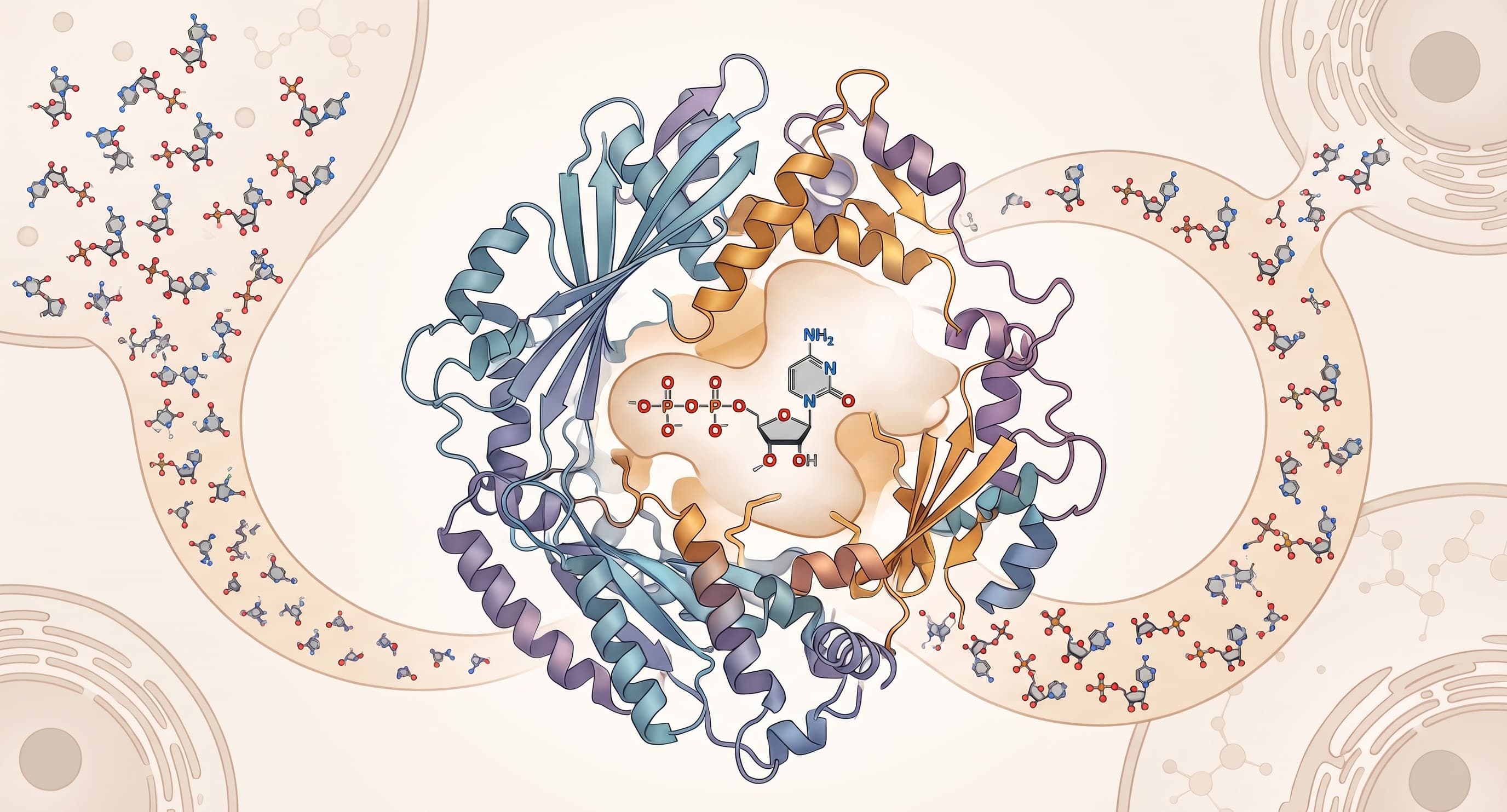
The lethal cytotoxicity of gemcitabine stems from a dual-action biochemical assault that crippled solid tumor proliferation. First, intracellular dFdCDP functions as a potent, mechanism-based irreversible inhibitor of the R1 catalytic subunit of ribonucleotide reductase, the rate-limiting enzyme responsible for de novo conversion of ribonucleoside diphosphates to deoxyribonucleoside diphosphates. Inactivating ribonucleotide reductase severely depletes the intracellular pool of natural deoxycytidine triphosphate (dCTP). This critical dCTP depletion triggers a self-potentiating kinetic loop, as the scarcity of dCTP relieves allosteric feedback inhibition on deoxycytidine kinase, driving even higher cellular accumulation of cytotoxic gemcitabine metabolites. Second, gemcitabine triphosphate competes directly against residual dCTP for incorporation into replicating DNA strands by DNA polymerases. Once dFdCTP is inserted into the nascent DNA daughter strand, DNA polymerase is capable of appending exactly one additional natural deoxynucleotide before elongation is irrevocably halted. This phenomenon--termed masked chain termination--buries the fluorinated fraudulent nucleotide one position inward from the growing 3'-terminus, rendering it completely invisible to the 3'-to-5' proofreading exonuclease proofreading machinery. Incapable of excising the lesion, replication forks collapse, generating catastrophic double-strand breaks that drive malignant cells into apoptotic death.
Eli Lilly originally anchored Gemzar with U.S. Patent No. 4,808,614 (the '614 patent), which claimed the gemcitabine compound itself, its chemical synthesis, and methods of using the molecule as an antiviral agent. Crucially, while the claims of the '614 patent did not specifically enumerate oncology treatments, the specification explicitly described in vitro biological testing demonstrating that gemcitabine exhibited potent antitumor activity against human leukemia cell lines. With the '614 patent set to expire in May 2010 (following statutory patent term extension under 35 U.S.C. 156), Lilly subsequently prosecuted U.S. Patent No. 5,464,826 (the '826 patent), containing claims specifically directed to methods of treating cancer--including solid tumors and non-small cell lung cancer--using gemcitabine. The '826 patent carried a nominal expiration date of November 7, 2012, threatening to lock generic competitors out of the oncology market for an extra two and a half years.
When Indian generic manufacturer Sun Pharmaceutical Industries filed an Abbreviated New Drug Application with a Paragraph IV certification to market generic gemcitabine, Sun Pharma launched a bold offensive, seeking a declaratory judgment that claims 2, 6, and 7 of Lilly's '826 patent were invalid for obviousness-type double patenting over the '614 patent. In defense, Lilly mounted a rigid doctrinal argument: because double patenting is grounded in preventing unjustified extensions of patent claims, courts should be strictly confined to comparing the claims of the earlier patent against the claims of the later patent without referencing the earlier specification. Lilly argued that because the '614 patent claimed only antiviral utilities, its later cancer method claims were patentably distinct. Writing for the Federal Circuit panel alongside Circuit Judges William C. Bryson and Arthur J. Gajarsa, Circuit Judge Sharon Prost rejected Lilly's defense. The court affirmed that under the established Schneller and Geneva precedent, where an earlier patent claims a composition of matter, the court may properly examine the earlier patent's specification to ascertain what utility was disclosed for that compound. Because Lilly's earlier '614 patent had already disclosed the antitumor activity of gemcitabine in its specification, claims in the later '826 patent directed to treating cancer with that very compound represented an obvious variation of the original invention. The landmark ruling opened the floodgates for affordable generic gemcitabine in May 2010, saving healthcare systems billions and cementing the principle that public disclosure in an original patent cannot be recycled into a secondary lifecycle monopoly.
What we do
See if this applies to one of your matters
We run genus/species (Markush) claim coverage analysis, Section 3(d) compliance screening, and prior-art structural triage on real chemical structures: not keyword search. If a case like this one is live for you, we'll run a free sample on a compound of your choosing.