
Retevmo (Selpercatinib): The 2037 Generic Opportunity Window
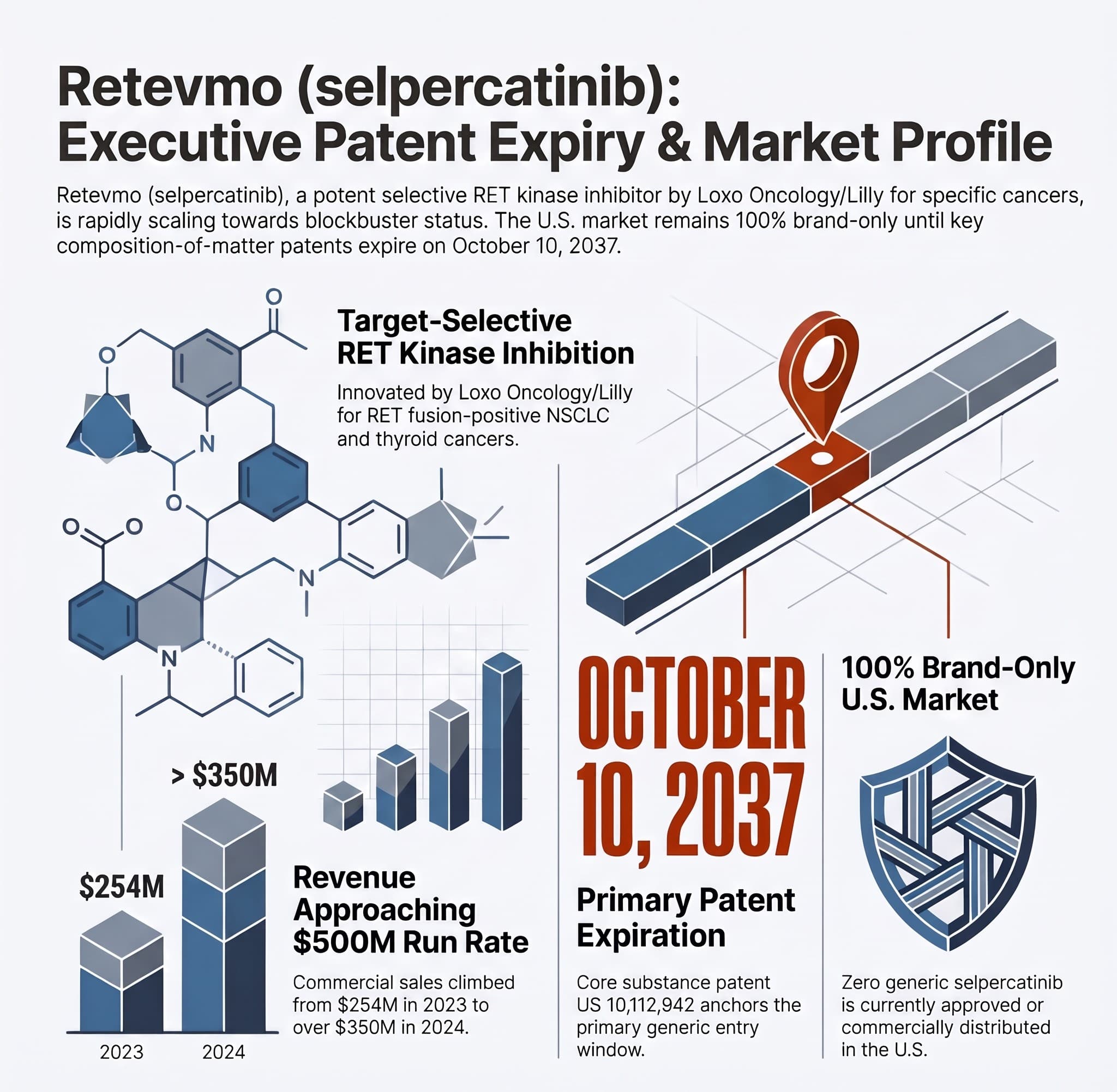
In precision oncology, receptor tyrosine kinase fusions represent oncogenic driver alterations capable of initiating aggressive tumorigenesis across diverse tissue types. For years, patients harboring rearrangements in the RET (Rearranged during Transfection) proto-oncogene relied on legacy multi-kinase inhibitors such as cabozantinib and vandetanib. However, these first-generation agents were burdened by narrow therapeutic margins and dose-limiting toxicities arising from potent off-target inhibition of VEGFR2, as well as rapid emergence of treatment-refractory gatekeeper mutations. To resolve this therapeutic impasse, Loxo Oncology (acquired by Eli Lilly and Company) rationally engineered Retevmo (selpercatinib), the first-in-class, highly selective small-molecule RET kinase inhibitor. Approved under FDA NDAs 213246 and 218160 as oral capsules (40 mg, 80 mg) and tablets (40 mg, 80 mg, 120 mg, 160 mg), Retevmo provides potent, durable clinical remissions in RET fusion-positive non-small cell lung cancer, RET-mutant medullary thyroid cancer, and across advanced RET fusion-positive solid tumors regardless of tumor histology. Commercial adoption has accelerated significantly, with annual worldwide sales climbing past $350 million in 2024 and pacing at a $450 to $500+ million run rate in 2025/2026, heading toward peak blockbuster revenues of $1.0 billion to $1.5+ billion USD. The molecular architecture of selpercatinib demonstrates state-of-the-art structure-guided drug design. Chemically designated as 6-(2-hydroxy-2-methylpropoxy)-4-(6-(6-((6-methoxypyridin-3-yl)methyl)-3,6-diazabicyclo[3.1.1]heptan-3-yl)pyridin-3-yl)pyrazolo[1,5-a]pyridine-3-carbonitrile, the compound is constructed upon a core pyrazolo[1,5-a]pyridine bicyclic scaffold. An electron-withdrawing carbonitrile group at C3 engages the kinase hinge region through hydrogen-bonding interactions, while a 2-hydroxy-2-methylpropoxy ether at C6 projects into solvent space, optimizing oral bioavailability and aqueous solubility. The pharmacophoric breakthrough resides at C4, where a 2-substituted pyridine ring is linked to a rigid, bridged 3,6-diazabicyclo[3.1.1]heptane diamine framework terminating in a (6-methoxypyridin-3-yl)methyl group. This geometrically constrained bicyclic spacer precisely orientates the pendant methoxypyridine into the solvent-exposed vestibule of the RET catalytic pocket. Crucially, selpercatinib avoids steric clash with bulky amino acid substitutions at the RET gatekeeper residue (V804M and V804L), maintaining low-nanomolar inhibitory potency against both wild-type RET and gatekeeper-mutant isoforms. Furthermore, selpercatinib exhibits greater than 100-fold to 1,000-fold selectivity over VEGFR2 and other kinases, avoiding the severe hypertension and renal toxicity seen with older multikinase inhibitors while demonstrating excellent blood-brain barrier permeability to control central nervous system metastases. Within the FDA Orange Book, the primary intellectual property perimeter safeguarding Retevmo is anchored by foundational chemical substance and composition-of-matter patents: U.S. Patent No. 10,112,942 (the '942 patent) alongside co-originating patents U.S. Patent Nos. 10,137,124, 10,172,851, and 10,786,489. All four core patents possess an unexpired statutory expiration date of October 10, 2037, establishing an intact eleven-year exclusivity runway for the innovator. Secondary patents claiming specific oral tablet dosage formulations, crystalline salt polymorphs, and combination regimens (such as U.S. Patent Nos. 11,192,896 and 11,547,705) project nominal protection into 2039 through 2041. Today, the commercial marketplace for selpercatinib in the United States remains 100 percent brand-only; zero generic versions are approved or commercially available. Five-year Hatch-Waxman New Chemical Entity exclusivity expired on May 8, 2025, unlocking Paragraph IV ANDA filing eligibility (which originally opened on May 8, 2024 at NCE-1). Leading Indian and global generic development powerhouses--including Natco Pharma, Dr. Reddy's Laboratories, Sun Pharma, MSN Laboratories, Cipla, and Hetero Labs--are actively mobilizing process chemistry teams to overcome the synthetic bottleneck of assembling the chiral bridged 3,6-diazabicyclo[3.1.1]heptane motif and filing Drug Master Files (DMFs) for active pharmaceutical ingredients targeting the October 2037 patent cliff. SCOPE NOTE: This analysis is based strictly on publicly disclosed FDA Orange Book patent listings, approved prescribing information, and corporate SEC financial filings. It reviews public patent expiration dates, chemical structures, and statutory regulatory milestones only. No opinion is expressed on unasserted patent claims, potential future Paragraph IV litigation, or confidential commercial settlements.
What we do
We track expirations like this continuously
This is one drug, picked for today's post. A Portfolio Retainer watches an entire portfolio or compound class on an ongoing basis and flags new matching filings as they publish.