
Welireg (Belzutifan): The 2034-2042 Generic Opportunity Window
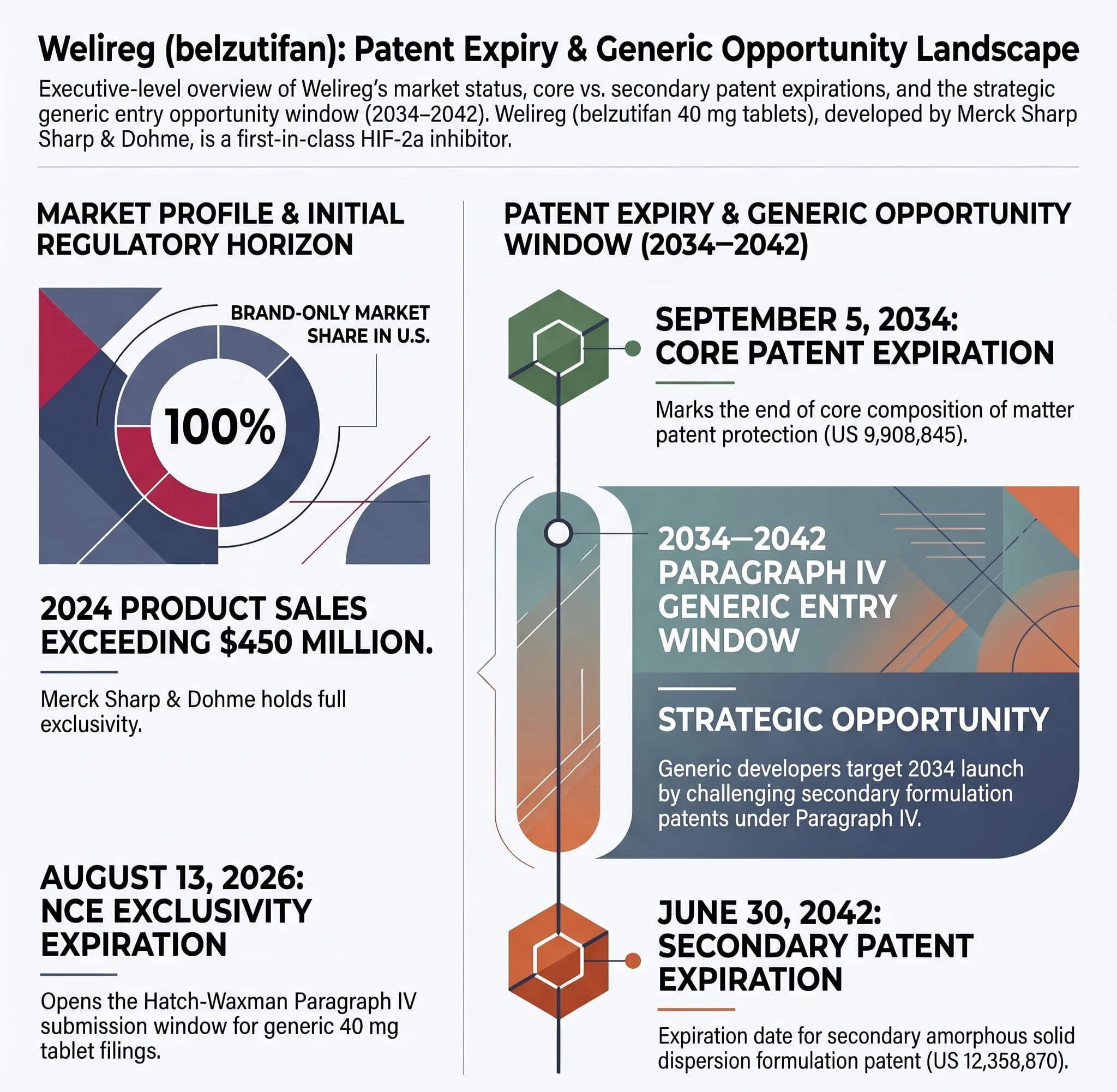
In the clinical management of hypoxia-driven malignancies, Merck Sharp & Dohme has secured a preeminent therapeutic franchise with Welireg (belzutifan). Approved under FDA NDA 215383 as 40 mg oral film-coated tablets, Welireg represents the first-in-class small-molecule hypoxia-inducible factor-2 alpha (HIF-2a) inhibitor. Originally synthesized by Peloton Therapeutics and acquired by Merck in a landmark $2.2 billion transaction, belzutifan received initial breakthrough approval for adult patients with von Hippel-Lindau (VHL) disease requiring treatment for associated renal cell carcinoma (RCC), central nervous system hemangioblastomas, or pancreatic neuroendocrine tumors, followed by expanded approval in advanced clear cell RCC progressing after sequential PD-1/PD-L1 checkpoint inhibitor and VEGF-targeted tyrosine kinase inhibitor therapy (LITESPARK-005). By binding with nanomolar affinity to the hydrophobic PAS-B cavity of HIF-2a, belzutifan allosterically obstructs heterodimerization with HIF-1b (aryl hydrocarbon receptor nuclear translocator, ARNT), selectively blocking the transcription of vascular endothelial growth factor (VEGF), cyclin D1, and glucose transporter-1 (GLUT1). Welireg generated over $450 million in 2024 global sales and accelerated toward $800 million in 2025, charting a trajectory toward peak blockbuster revenues of $1.5 billion to $2.0+ billion as frontline combination regimens mature. The intellectual property architecture safeguarding Welireg in the FDA Orange Book is anchored by a dense combination of core chemical substance and specialized formulation patents. Belzutifan is (S)-3-((1S,2S,3R)-2,3-difluoro-1-hydroxy-7-(methylsulfonyl)-2,3-dihydro-1H-inden-4-yloxy)-5-fluorobenzonitrile, a densely functionalized indan-1-ol core possessing three contiguous chiral stereocenters, two fluorine atoms, an electron-withdrawing methylsulfonyl group, and a fluorobenzonitrile ether. The primary chemical substance and drug product claims are protected under U.S. Patent No. 9,908,845 and reissue U.S. Patent No. RE49,948, which expire on September 5, 2034, following Patent Term Extension under 35 U.S.C. 156. Beyond the core compound cliff, Merck maintains secondary method-of-use coverage under U.S. Patent No. 10,335,388 (claiming combinations with checkpoint inhibitors) expiring April 14, 2036. Crucially, because belzutifan exhibits poor aqueous solubility (BCS Class II/IV biopharmaceutics), commercial tablets require specialized amorphous solid dispersions spray-dried in polymer matrices (such as hypromellose acetate succinate) to maintain supersaturation, a technology Merck protected under secondary U.S. Patent No. 12,358,870 with statutory expiration extending through June 30, 2042. Today, the commercial market for belzutifan in the United States remains 100 percent brand-only, with zero generic versions approved or commercially distributed. However, under the Hatch-Waxman statutory framework, Welireg's 5-year New Chemical Entity (NCE) exclusivity expired on August 13, 2026, while the NCE-1 Paragraph IV submission window opened in August 2025. Leading Indian and global generic pharmaceutical developers, including Natco Pharma, Cipla, Dr. Reddy's Laboratories, and Sun Pharma, are actively advancing bioequivalent generic 40 mg formulations. The technical barrier to entry demands asymmetric stereoselective synthesis of the chiral difluoroindanol intermediate and robust scale-up of amorphous solid dispersions to match commercial dissolution profiles. The eight-year divergence between the primary September 5, 2034 substance expiration and the June 30, 2042 formulation perimeter delineates an exceptionally lucrative generic opportunity window. Generic applicants capable of designing non-infringing solid dispersions or invalidating secondary formulation claims stand to access a multi-billion-dollar oncology market years ahead of portfolio expiration. SCOPE NOTE: This analysis is based strictly on publicly disclosed FDA Orange Book patent listings, approved prescribing information, and corporate financial disclosures. Following the expiration of statutory NCE exclusivity, generic applicants have submitted Abbreviated New Drug Applications with Paragraph IV certifications challenging listed patents. This analysis reviews public patent claims and regulatory milestones only, and expresses no opinion on unresolved patent claims, pending Paragraph IV litigation, or confidential commercial settlements.
What we do
We track expirations like this continuously
This is one drug, picked for today's post. A Portfolio Retainer watches an entire portfolio or compound class on an ongoing basis and flags new matching filings as they publish.