
Sotyktu (Deucravacitinib): The 2033-2043 Generic Opportunity Window
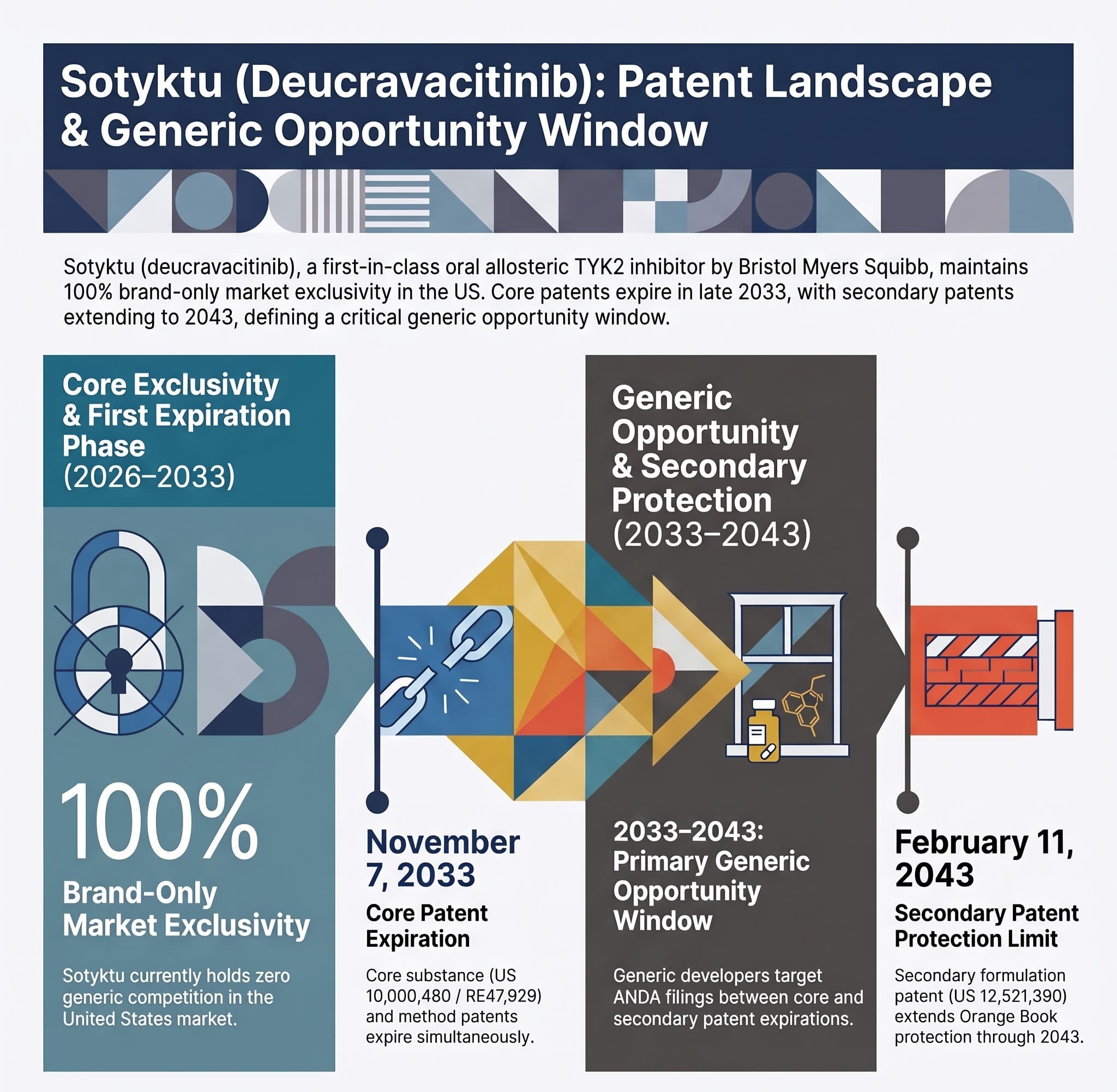
In the rapidly evolving landscape of oral therapies for chronic autoimmune disorders, Bristol Myers Squibb has established a commanding position with Sotyktu (deucravacitinib). Approved under FDA NDA 214958 as a 6 mg once-daily film-coated oral tablet, Sotyktu represents the first-in-class, selective allosteric tyrosine kinase 2 (TYK2) inhibitor for adult patients with moderate-to-severe plaque psoriasis who are candidates for systemic therapy or phototherapy. By intentionally bypassing the highly conserved adenosine triphosphate (ATP) catalytic pocket (JH1 domain) targeted by conventional Janus kinase inhibitors, deucravacitinib binds with high affinity to the distinct regulatory pseudokinase (JH2) domain of TYK2. This allosteric engagement stabilizes an autoinhibitory conformation that selectively shuts down cytokine signaling through interleukin-23 (IL-23), IL-12, and type I interferons while achieving greater than 10,000-fold functional selectivity over JAK1, JAK2, and JAK3. Consequently, Sotyktu delivers biologic-level clinical clearance without the class-wide boxed warnings for cardiovascular events, thrombosis, and malignancies that encumber catalytic pan-JAK agents. Commercial revenues surpassed $250 million in 2024 and are accelerating toward $500 million in 2025-2026, with Bristol Myers Squibb targeting $3 billion to $4 billion in peak annual sales as ongoing phase 3 trials in psoriatic arthritis, systemic lupus erythematosus, and inflammatory bowel disease expand its clinical indications. The intellectual property protection surrounding Sotyktu is distinguished by an elegant intersection of allosteric design and medicinal isotope chemistry. Deucravacitinib incorporates a deuterated methyl carboxamide, 6-(cyclopropanecarboxamido)-4-{[2-methoxy-3-(1-methyl-1H-1,2,4-triazol-3-yl)phenyl]amino}-N-(^2H_3)methylpyridazine-3-carboxamide, where three deuterium atoms replace hydrogen on the terminal methyl group. By exploiting the carbon-deuterium kinetic isotope effect, this heavy-isotope substitution retards cytochrome P450-mediated oxidative demethylation, extending metabolic stability and systemic exposure without altering target-binding kinetics. In the FDA Orange Book, Sotyktu's core chemical barrier is anchored by U.S. Patent No. RE47,929 (a reissue of U.S. Patent No. 9,505,748) and U.S. Patent No. 10,000,480, both covering the active drug substance and pharmaceutical product with statutory protection extending through November 7, 2033. Accompanying method-of-use protection in U.S. Patent No. 11,021,475 also terminates on November 7, 2033. Beyond this core 2033 substance cliff, Bristol Myers Squibb has constructed a secondary patent perimeter anchored by U.S. Patent No. 12,521,390, which covers specific drug product formulations and therapeutic regimens through February 11, 2043. Today, the United States market for deucravacitinib is 100 percent brand-only, with zero generic versions approved or commercially distributed. However, under the Hatch-Waxman statutory framework, Sotyktu's four-year New Chemical Entity (NCE) exclusivity barrier opened for generic challenge on September 9, 2026 (the NCE-1 filing date). This statutory milestone permits generic developers to submit Abbreviated New Drug Applications (ANDAs) containing Paragraph IV patent certifications. Leading global and Indian generic pharmaceutical powerhouses, including Dr. Reddy's Laboratories, MSN Laboratories, Aurobindo Pharma, Hetero Labs, Sun Pharma, Cipla, and Zydus Lifesciences, have prioritized deucravacitinib development programs. Generic filers are actively scaling commercial synthetic routes for the trideuteromethylamine precursor, optimizing scalable solid-state crystallization processes, and establishing Drug Master Files. The ten-year divergence between the primary 2033 substance expiration and the 2043 secondary formulation perimeter delineates an exceptionally high-value generic opportunity window. Generic applicants capable of navigating or successfully invalidating secondary formulation claims stand to unlock a multi-billion-dollar oral autoimmune market years ahead of total portfolio expiration. SCOPE NOTE: This analysis is based strictly on publicly disclosed FDA Orange Book patent listings, approved prescribing information, and corporate SEC and financial disclosures. It excludes non-public Paragraph IV certifications, confidential commercial licensing terms, and ongoing international administrative patent oppositions.
What we do
We track expirations like this continuously
This is one drug, picked for today's post. A Portfolio Retainer watches an entire portfolio or compound class on an ongoing basis and flags new matching filings as they publish.