
Astra Formulated an In Situ Barrier to Shield Omeprazole. The Federal Circuit Held Inherent Anticipation Invalidated the Process.
By Prashant Kotian, PhD Researcher (Chemistry), ICT Mumbai
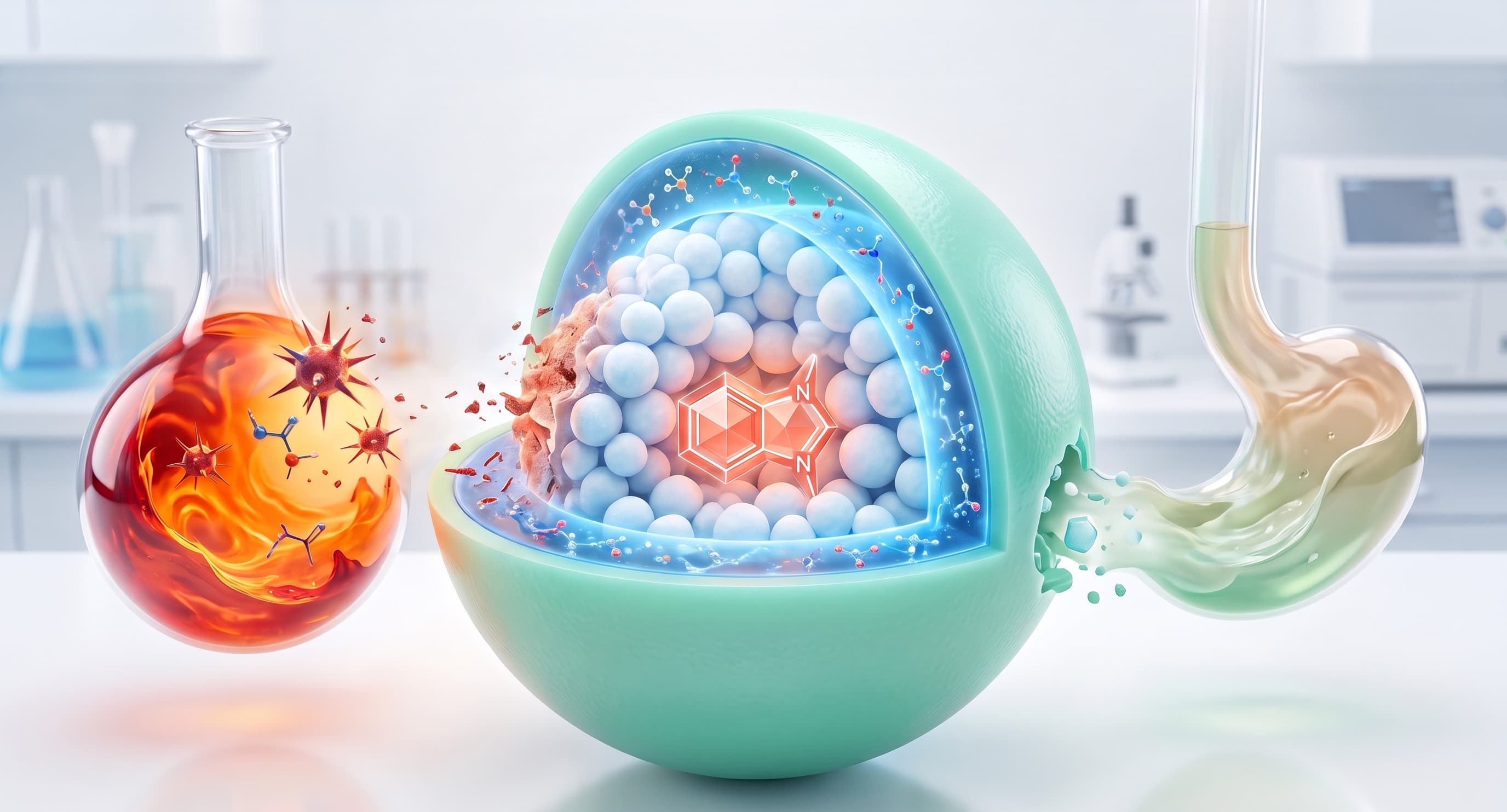
When medicinal chemists at Astra AB (now AstraZeneca) synthesized omeprazole in 1979, they unlocked a transformative therapeutic mechanism: targeted, covalent inhibition of the H+/K+-ATPase gastric proton pump. Yet translating the substituted benzimidazole core into a viable commercial oral dosage form presented one of the most stubborn formulation challenges in modern pharmaceutical history. In gastric fluid with a pH between 1.0 and 2.0, omeprazole undergoes catastrophic acid-catalyzed degradation within minutes. The sulfinyl sulfur atom experiences rapid nucleophilic attack, collapsing the molecule into colored, inactive tetracyclic sulfonamides and complex polymeric gums. To preserve oral bioavailability, the active drug must be sealed behind an enteric coating that remains completely insoluble through the stomach, dissolving only upon reaching the neutral-to-alkaline pH of the duodenum.
The fundamental chemistry conflict arose from the polymers used to achieve that enteric protection. Standard enteric coating materials, such as hydroxypropyl methylcellulose phthalate (HPMCP), cellulose acetate phthalate, and methacrylic acid copolymers, are acidic polymers laden with free carboxylic acid groups (-COOH). To prevent omeprazole from degrading under ordinary ambient conditions, formulation scientists routinely blend the active compound with an alkaline reacting compound (ARC), such as disodium hydrogen phosphate, sodium carbonate, or magnesium oxide, establishing a microenvironmental pH above 7.0 within the pellet core. However, spraying an acidic enteric polymer solution directly onto an alkaline-stabilized omeprazole core triggers an aggressive solid-state reaction at the interface during processing and long-term shelf storage. Protons from the enteric polymer migrate directly across the boundary, initiating localized acid hydrolysis of omeprazole and turning the formulation discolored and chemically degraded.
Astra initially resolved this formulation bottleneck in the late 1980s by constructing a three-layer pellet system protected by U.S. Patent Nos. 4,786,505 and 4,853,230. In that architecture, a separate, mechanical, water-soluble intermediate subcoating, typically composed of neutral hydroxypropyl methylcellulose (HPMC), was sprayed over the alkaline core before applying the acidic enteric outer layer. The mechanical subcoat served as a physical spacer, isolating the acidic polymer from the basic core. But applying a discrete intermediate layer required an extra coating step, dedicated fluid-bed drying cycles, and increased manufacturing costs. Seeking a more efficient shortcut that could also extend its exclusivity perimeter, Astra filed U.S. Patent No. 6,013,281 (the '281 patent) in December 1997. The '281 patent claimed a method of manufacturing enteric-coated omeprazole pellets without applying a separate mechanical subcoat: by directly coating an alkaline core with an acidic enteric polymer, an intermediate separating layer was formed in situ through the spontaneous acid-base neutralization between the core's alkaline stabilizer and the polymer's carboxylic acid groups.

When generic challengers including Cheminor Drugs Ltd. (which later merged into Dr. Reddy's Laboratories), Andrx Pharmaceuticals, and Genpharm submitted Abbreviated New Drug Applications (ANDAs) with Paragraph IV certifications targeting Prilosec, Astra asserted claims 1, 2, 3, 7, 16, 20, and 21 of the '281 patent. The generic applicants countered that the '281 patent was invalid under 35 U.S.C. 102 as anticipated by Korean Patent Application No. 91-5835, published on November 5, 1991, by Chong Kun Dan Corporation (CKD). The CKD reference disclosed manufacturing enteric-coated omeprazole pellets containing an alkaline stabilizer (such as sodium phosphate or arginine) directly coated with HPMCP, employing the exact ingredients, ratios, and processing conditions set forth in Example 1 of Astra's '281 patent. Although CKD's specification described a direct two-layer system and did not mention an intermediate separating layer, practicing CKD's recipe inevitably brought the alkaline core stabilizer and the acidic enteric polymer into direct physical contact.
What elevated the dispute into an extraordinary litigation case study was the evidentiary boomerang created by Astra's prior foreign litigation. Years earlier, Astra had sued CKD for patent infringement in South Korea, asserting its earlier formulation patents. In that Korean proceeding, Astra's own expert witnesses performed microscopic cross-sectional analyses and physicochemical testing on CKD's commercial pellets, successfully convincing the Korean courts that CKD's manufacturing process inherently and inevitably generated an in situ separating subcoat at the core-coating interface. In the U.S. litigation before District Judge Barbara S. Jones in the Southern District of New York, Cheminor and Andrx turned Astra's own Korean admissions and scientific evidence directly against the '281 patent, demonstrating that any artisan following CKD's prior art disclosure would naturally and unavoidably create the claimed in situ separating layer.
Astra attempted to avoid anticipation by arguing that CKD did not inherently anticipate the '281 claims because CKD never recognized, appreciated, or intended to produce an in situ separating layer. In an opinion authored by Circuit Judge Randall R. Rader and joined by Circuit Judge William C. Bryson, the Federal Circuit firmly rejected Astra's position and affirmed the invalidation of the asserted '281 patent claims. Reaffirming the foundational doctrine articulated in Schering Corp. v. Geneva Pharmaceuticals (339 F.3d 1373), the appellate panel held that inherent anticipation does not require contemporaneous recognition or appreciation in the prior art. If the natural and inevitable consequence of practicing a disclosed prior art recipe produces the claimed physical structure or chemical reaction, the subject matter is fully anticipated under Section 102.
Writing for the court, Judge Rader underscored that an inventor cannot remove a known manufacturing process from the public domain simply by discovering and naming a previously unappreciated chemical reaction that inherently occurs during its execution. Because CKD disclosed every formulation component, proportion, and operational step necessary to carry out the process, the spontaneous in situ salt formation was a necessary physical reality of the prior art rather than a patentable invention. For pharmaceutical IP strategists and generic formulation teams, In re Omeprazole Patent Litigation remains a definitive warning: claiming in situ chemical reactions cannot resuscitate patentability over old processes, and scientific admissions made in foreign enforcement actions can decisively destroy corresponding patent portfolios in U.S. Hatch-Waxman litigation.
What we do
See if this applies to one of your matters
We run genus/species (Markush) claim coverage analysis, Section 3(d) compliance screening, and prior-art structural triage on real chemical structures: not keyword search. If a case like this one is live for you, we'll run a free sample on a compound of your choosing.