
Azurity Disclaimed Propylene Glycol to Win Its Patent. It Could Not Stop Alkem.
By Prashant Kotian, PhD Researcher (Chemistry), ICT Mumbai
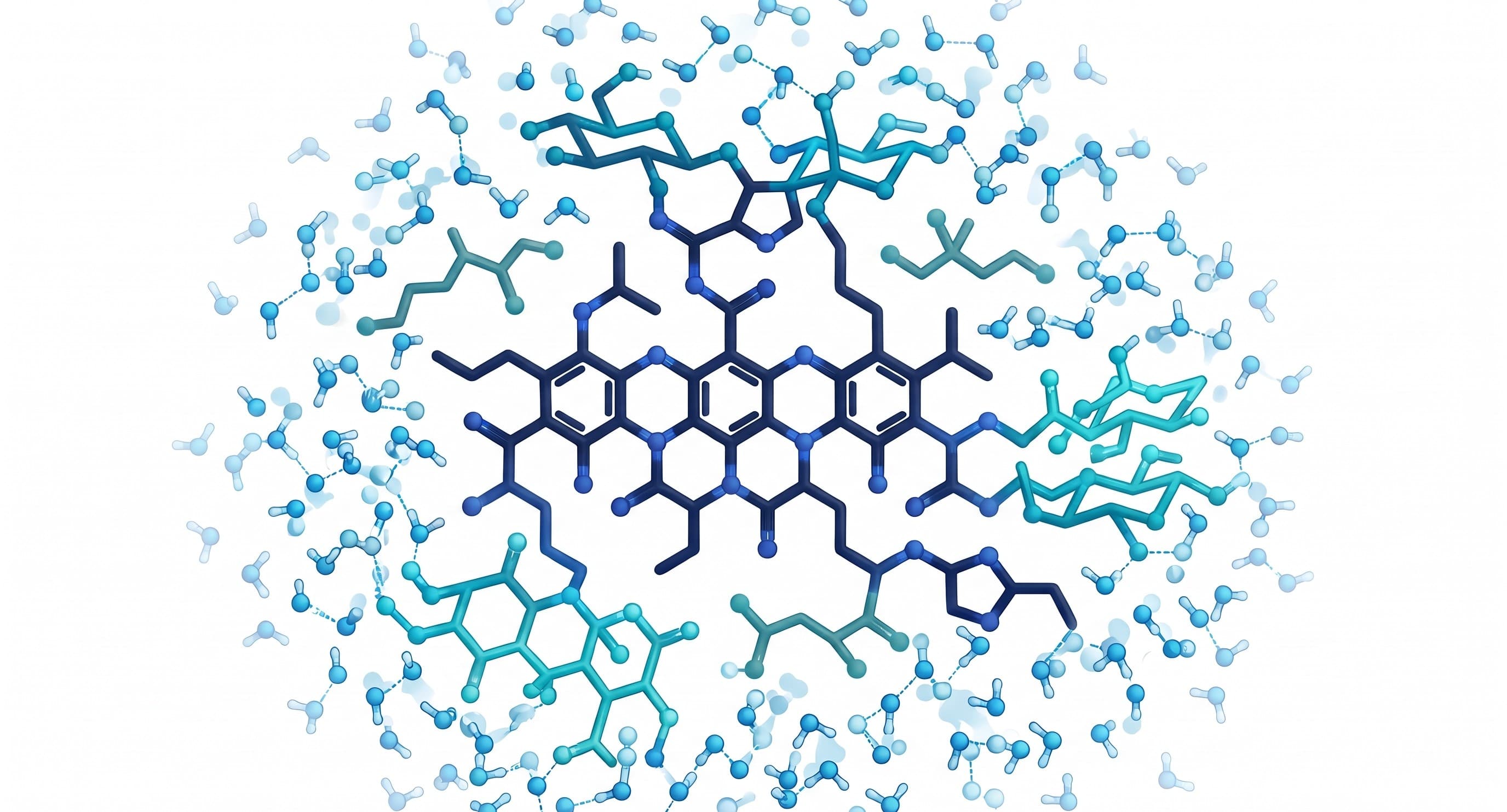
Liquid formulation chemistry is often a balancing act between solubility, chemical degradation, and organoleptic palatability. In the Hatch-Waxman arena, that chemical balancing act frequently collides with the strict doctrine of prosecution history disclaimer.
That collision was on full display in Azurity Pharmaceuticals, Inc. v. Alkem Laboratories Ltd. (Fed. Cir. No. 2023-1977, decided April 8, 2025), where the U.S. Court of Appeals for the Federal Circuit affirmed that brand pharmaceutical patentee Azurity could not enforce its oral vancomycin patent against Indian generic manufacturer Alkem Laboratories. The ruling offers a textbook demonstration of how aggressive concessions made during patent prosecution permanently circumscribe enforcement options against generic formulators.
The Chemistry of Liquid Vancomycin
Vancomycin is a complex glycopeptide antibiotic composed of a tricyclic heptapeptide core decorated with vancosamine and glucosyl carbohydrate moieties. For decades, it has served as a frontline therapy for severe Gram-positive bacterial infections, particularly oral administration for Clostridium difficile (C. diff)-associated diarrhea and enterocolitis.
However, formulating vancomycin as a stable aqueous solution is notoriously difficult. In the presence of water, vancomycin undergoes hydrolytic degradation, deamidation of its asparagine residues, and epimerization, forming crystalline degradation products (CDP-1) that destroy therapeutic potency. Because of this chemical instability, hospitals historically had to reconstitute intravenous vancomycin powder into oral syrups extemporaneously, resulting in short refrigerator shelf lives and foul-tasting solutions that discouraged pediatric and geriatric patient compliance.
Azurity Pharmaceuticals (formerly CutisPharma) commercialized Firvanq, a convenient compounding kit containing pre-measured vancomycin hydrochloride dry powder and an aqueous diluent containing sweetening and flavoring agents, producing a 25 mg/mL or 50 mg/mL oral liquid solution stable for up to 14 days under refrigeration.
To protect this liquid franchise, Azurity secured U.S. Patent No. 10,959,948 ('the '948 patent'), titled 'Liquid Vancomycin Formulations.'
The Prosecution Wall: Distinguishing the Palepu Prior Art
The legal downfall of the '948 patent began years before litigation, during the prosecution of its parent application (No. 15/126,059).
The USPTO patent examiner repeatedly rejected Azurity's pending formulation claims over a prior art patent application known as Palepu (U.S. Patent Application Publication 2016/0101147). Palepu disclosed liquid vancomycin formulations stabilized against hydrolytic degradation by utilizing a polar non-aqueous organic solvent system comprising propylene glycol and lactic acid.
To escape Palepu and persuade the examiner to grant allowance, Azurity took two decisive, narrow-tailored drafting steps:
1. It amended its claim transition language from open ('comprising') to strictly closed ('consisting of'). The resulting independent claims recited a liquid formulation 'consisting of' a buffering agent, water, a sweetener, a preservative, vancomycin hydrochloride, and a flavoring agent.
2. It submitted explicit, emphatic written arguments distinguishing its invention from Palepu's solvent system. Azurity explicitly told the USPTO: 'The absence of propylene glycol and polyethylene glycol in the claimed invention, in part, distinguish it from [Palepu].' Azurity's declarant further testified that 'the diluent and the compounded solutions do not have propylene glycol,' and Azurity's attorney argued that the claimed formulation 'does not include the polar solvents or lactic acid of Palepu.'
Persuaded by this categorical disavowal, the examiner allowed the claims, stating in the Reasons for Allowance: 'The instant claims exclude the presence of propylene glycol or polyethylene glycol in view of the consisting of language, and thus overcome the teachings of Palepu which requires the propylene glycol or polyethylene glycol to be present.'
Alkem's Generic ANDA and the 'Mix-and-Match' Theory
Alkem Laboratories Ltd., a prominent generic pharmaceutical manufacturer headquartered in Mumbai, India, submitted an Abbreviated New Drug Application (ANDA) to the FDA seeking approval to market a generic oral vancomycin hydrochloride solution.
When developing its generic formulation, Alkem's scientists included propylene glycol in the product for two distinct roles: directly as an intentional co-solvent, and as an excipient component inside its commercial grape flavoring mixture ('Grape Flavor 501417C', which consists of propylene glycol, flavoring substances, and ascorbic acid).
Azurity filed suit in the U.S. District Court for the District of Delaware, alleging that Alkem's ANDA infringed claims 5, 7, 8, and 9 of the '948 patent.
Faced with its own prosecution record and the closed 'consisting of' claim preamble, Azurity advanced a novel 'mix-and-match' infringement theory. Azurity argued that all the propylene glycol in Alkem's product--even the portions added separately as a co-solvent--could be lumped together and legally deemed part of the claimed 'flavoring agent.'
Azurity also leaned heavily on a pretrial discovery stipulation, in which the parties had agreed that: 'Suitable flavoring agents for use in the Asserted Claims include flavoring agents with or without propylene glycol.' Azurity claimed this stipulation operated as a formal concession by Alkem that any flavoring agent containing propylene glycol satisfied the claim limitations.
The Federal Circuit Ruling: Sweeping Statements Yield Sweeping Disclaimers
Following a two-day bench trial, Chief Judge Mitchell S. Goldberg of the District of Delaware found that Alkem did not infringe, ruling that Azurity had clearly and unmistakably disclaimed propylene glycol.
On appeal, the Federal Circuit unanimously affirmed in a precedential decision authored by District Judge Stephen R. Murphy III (sitting by designation with Chief Judge Moore and Circuit Judge Chen).
The Federal Circuit dismantled Azurity's arguments across every front:
1. Pretrial Stipulations Must Be Read in Context: The appellate court firmly rejected Azurity's attempt to convert the discovery stipulation into an automatic concession of infringement. The court noted that the joint pretrial order began with Alkem's express position that it did not infringe due to the presence of propylene glycol. The stipulation merely clarified that in the flavor-chemistry field, suitable flavoring agents did not necessarily require propylene glycol; it was never an admission that an unrecited, disclaimed chemical component could be smuggled into the formulation.
2. Unilateral Statements in Distant Applications Carry No Weight: Azurity pointed to statements made in a parallel patent application ('the '421 application') in an effort to walk back its earlier remarks. The court dismissed this argument, noting that the '421 application was merely a 'grand-nephew' application prosecuted after the examiner had already allowed the direct ancestor claims. Under foundational public notice principles, patent applicants cannot undo public disclaimers made to secure allowance by filing self-serving remarks in distant collateral applications.
3. The Echo Matches the Shout: Most critically, the Federal Circuit reinforced the breadth of prosecution surrender under established precedent (such as Technology Properties Ltd. LLC v. Huawei Technologies Co.). Addressing Azurity's plea that its disclaimer should be limited only to carrier solvents rather than flavoring agents, the court held:
'Azurity's repeated, sweeping statements--endorsed by the examiner--return an equally sweeping disclaimer. Just as the echo matches the shout... the scope of surrender is not limited to what is absolutely necessary to avoid a prior art reference; patentees may surrender more than necessary.'
Because Azurity's disclaimer was complete and unequivocal, and because Alkem's generic ANDA formulation undisputedly contains propylene glycol, Alkem was entitled to a judgment of non-infringement as a matter of law.
Strategic Implications for Generic Formulation and Patent Drafting
The Azurity v. Alkem decision delivers several vital lessons for pharmaceutical patent practitioners and generic formulation teams:
- Excipient Disclaimer as a Design Pathway: Generic formulation teams closely scrutinizing brand prosecution histories can discover powerful, ironclad design-around avenues. When an innovator explicitly disclaims a functional excipient (such as an alcohol, polyol, or preservative) to overcome obviousness or anticipation rejections, that disclaimed chemical becomes an impenetrable shield against patent infringement.
- The Danger of the 'Consisting Of' Trap: While adopting 'consisting of' transitions is a standard examiner-pleasing tactic to push recalcitrant chemical claims through the USPTO, it severely weakens the patentee's commercial enforcement perimeter. Innovators who sacrifice intermediate transitional language ('consisting essentially of') leave themselves vulnerable to competitor formulations incorporating even minor unlisted excipients.
- Public Notice Prevails: Patentees cannot treat patent prosecution as an elastic negotiation where statements made to secure grant can later be disavowed when a generic competitor arrives. Once a chemical class or solvent system is surrendered on the public record, courts will enforce that boundary to the full extent of the applicant's own words.
What we do
See if this applies to one of your matters
We run genus/species (Markush) claim coverage analysis, Section 3(d) compliance screening, and prior-art structural triage on real chemical structures: not keyword search. If a case like this one is live for you, we'll run a free sample on a compound of your choosing.