
Novartis Sued on an Unlisted Amorphous Entresto Patent. The Federal Circuit Said MSN Never Made It.
By Prashant Kotian, PhD Researcher (Chemistry), ICT Mumbai
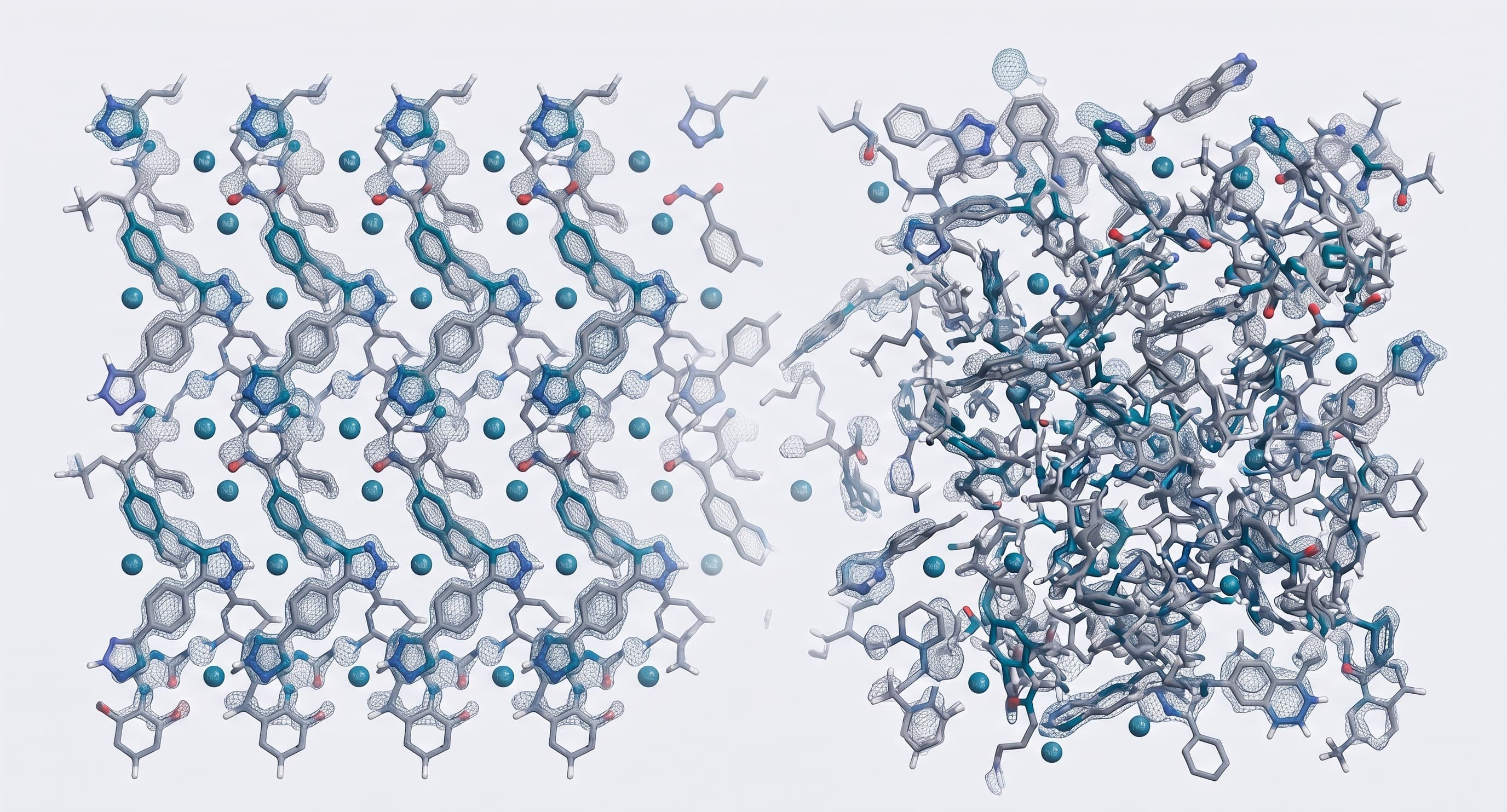
Entresto (sacubitril/valsartan), Novartis's dual-acting angiotensin receptor-neprilysin inhibitor (ARNI), generated more than $3 billion in U.S. sales in 2023 alone. The innovator's commercial product is not a simple physical blend of two active ingredients; it is a precisely engineered supramolecular crystalline complex--specifically, a trisodium hemipentahydrate co-crystal coordinating anionic valsartan, anionic sacubitril, and sodium cations in a 1:1:3 stoichiometric ratio.
For generic pharmaceutical manufacturers, breaking through Entresto's extensive patent thicket has demanded sophisticated solid-state chemistry. When Indian generic leader MSN Laboratories Private Ltd. (Hyderabad) developed an alternative crystalline entity designated "Form-S" for its Abbreviated New Drug Application (ANDA), Novartis turned to an unusual secondary weapon: U.S. Patent No. 11,096,918 ('the '918 patent').
Unlike standard Orange Book-listed patents, the '918 patent is not listed for Entresto. Indeed, Novartis conceded before the courts that the '918 patent does not cover the commercial Entresto product. Instead, the '918 patent claims an "amorphous solid form" of the 1:1:3 trisodium valsartan sacubitril (TVS) compound:
Claim 1 recites: "An amorphous solid form of a compound comprising anionic [valsartan], anionic [sacubitril], and sodium cations in a 1:1:3 molar ratio." Claim 2 recites: "A pharmaceutical composition comprising the amorphous solid form according to claim 1 and at least one pharmaceutically acceptable excipient."
Novartis deployed this unlisted patent offensively. Recognizing that generic filers might seek to bypass the crystalline co-crystal patents by formulating alternative solid states, Novartis asserted that MSN's finished tablets infringed Claim 2.
Novartis conceded that MSN's isolated active pharmaceutical ingredient (API)--Form-S--did not infringe the '918 patent upon synthesis. Instead, Novartis constructed an in situ conversion theory: it argued that during the physical stress of commercial tablet manufacturing--compression, milling, compaction, and excipient blending--an amorphous TVS supramolecular complex was generated within the finished tablet matrix.
To prove this theory, Novartis retained Dr. Adam Matzger, who conducted confocal Raman spectroscopy mapping across cross-sections of MSN's finished generic tablets. Dr. Matzger identified Raman spectral peaks in certain regions of the tablets that he asserted matched an amorphous TVS reference spectrum, concluding that amorphous TVS was present and predominated over crystalline forms.
The case came before Judge Richard G. Andrews in the U.S. District Court for the District of Delaware on Novartis's motion for a preliminary injunction. MSN vigorously contested both claim construction and infringement. MSN's expert, Dr. Jonathan Steed, exposed a glaring flaw in Novartis's analytical testing: Dr. Matzger had compared the Raman spectra from MSN's final product to reference spectra for crystalline valsartan, crystalline sacubitril, and amorphous TVS--but he had never compared those spectra to a reference spectrum of crystalline Form-S.
When Dr. Steed conducted that comparison, the spectral peaks that Dr. Matzger pointed to as supposed proof of amorphous TVS aligned closely with crystalline Form-S. Rather than demonstrating tableting-induced phase amorphization, the Raman data reflected the presence of MSN's intended crystalline API.
Furthermore, MSN demonstrated through characterization data submitted to the FDA that Form-S is a distinct crystalline form, directly countering Novartis's assertion that Form-S was merely an unreacted physical mixture. Under the Federal Circuit's established Hatch-Waxman precedent in Par Pharmaceutical v. Eagle Pharmaceuticals, when an ANDA specification defines a generic product in a manner that addresses infringement, that regulatory specification controls.
Judge Andrews denied Novartis's motion for a preliminary injunction, holding that Novartis failed to establish a likelihood of success in proving that MSN's generic product contains any amorphous TVS, and failed to prove irreparable harm.
Novartis appealed to the U.S. Court of Appeals for the Federal Circuit (Appeal Nos. 2024-2211, 2024-2212). In a decision authored by Circuit Judge Alan D. Lourie and joined by Circuit Judges Sharon Prost and Jimmie V. Reyna, the Federal Circuit affirmed the denial of injunctive relief in full.
Writing for the panel, Judge Lourie rejected Novartis's challenge to the district court's analytical scrutiny:
"MSN rebutted Novartis's argument by putting forth evidence to show that the supposed amorphous TVS regions identified by Dr. Matzger in the final product were actually indicative of crystalline TVS. It did so through its own expert, Dr. Steed, who compared the spectra Dr. Matzger obtained from the final product to a Form-S reference spectrum, finding them to 'align closely'... Considering this competing evidence, as well as the fact that Novartis bore the burden of proof, the district court found that Novartis did not persuasively show that it was likely to succeed in proving that MSN's ANDA products contain amorphous TVS. That finding was not clearly erroneous."
The Federal Circuit also affirmed the district court's finding regarding Form-S:
"Furthermore, we see no clear error in the district court's determination that Novartis failed to establish that Form-S is not crystalline TVS... Namely, MSN submitted the various testing data it had submitted to the FDA with its ANDA establishing that Form-S is crystalline TVS... Novartis challenged the reliability of those data, arguing that they do not actually establish that Form-S is crystalline TVS as opposed to a physical mixture. Again faced with compelling evidence from both parties, it was not clearly erroneous for the district court to determine that Novartis, the party bearing the burden of proof, did not establish a likelihood of success on the issue."
In closing, Judge Lourie addressed the district court's claim construction. Judge Andrews had construed "an amorphous solid form of a compound" to require that the amorphous form "predominates" over crystalline forms. While Judge Lourie expressed concern with that construction--noting that the intrinsic patent specification contained virtually no guidance on quantitative thresholds--the court held that any construction error was harmless:
"Before closing, we note that our holding today would be the same even if Novartis is correct that the district court's claim construction, requiring amorphous TVS to 'predominate,' is erroneous as a matter of law. Indeed, we admit concern with the district court's construction, particularly in light of its acknowledgement that there is 'virtually no useful guidance' in the intrinsic record supporting its conclusion that the claims require any particular amount of amorphous TVS to be present... But because we have affirmed the district court's conclusion that Novartis failed to establish that the accused product contains any amorphous TVS, any error in the claim construction, at this stage, is harmless."
The Federal Circuit's decision provides a vital lesson for pharmaceutical patent litigation involving solid-state forms and formulation analytics: 1. Offensive assertion of unlisted secondary patents requires bulletproof analytical chemistry. Speculative in situ conversion arguments cannot substitute for rigorous spectral controls. 2. Raman spectroscopy mapping in complex multicomponent tablets must account for all relevant solid-state crystalline references, including the defendant's proprietary API polymorphs and solvates. Omitting the generic's own crystalline form from chemometric libraries is fatal. 3. For Indian generic manufacturers navigating high-stakes small-molecule portfolios, rigorous solid-state characterization in FDA regulatory filings remains the strongest shield against infringement claims based on transient phase transformations.
What we do
See if this applies to one of your matters
We run genus/species (Markush) claim coverage analysis, Section 3(d) compliance screening, and prior-art structural triage on real chemical structures: not keyword search. If a case like this one is live for you, we'll run a free sample on a compound of your choosing.