
Purdue's Coating Pan Had Never Cured a Pill Before. That's Exactly Why Its Patent Was Obvious.
By Prashant Kotian, PhD Researcher (Chemistry), ICT Mumbai
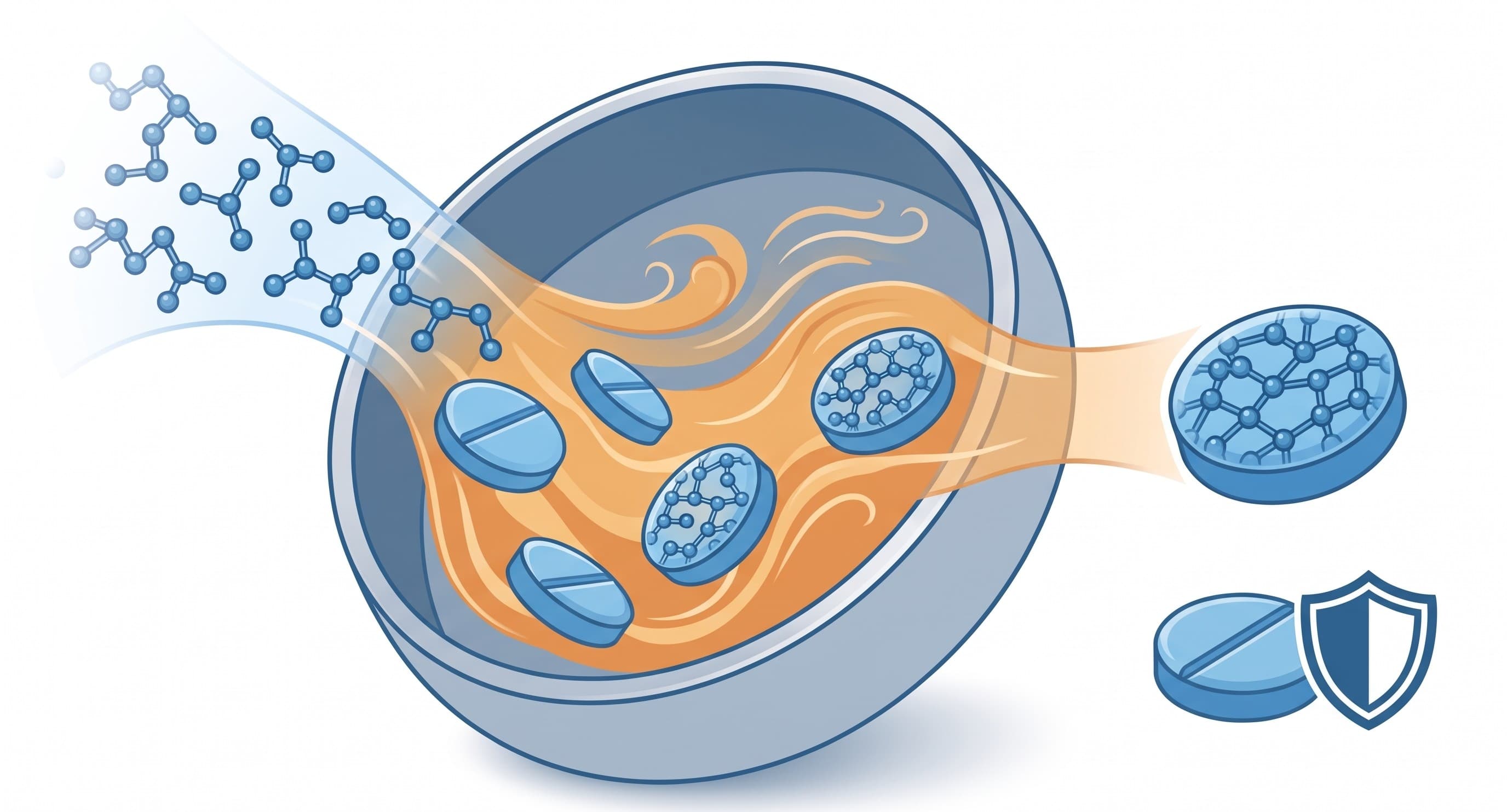
In 1995, Purdue Pharma won FDA approval for OxyContin: an oxycodone tablet built around a polymer matrix designed to release its opioid payload slowly, over about twelve hours. That design worked exactly as intended for a patient who swallowed the pill whole. It also created an obvious point of attack for anyone who didn't. Crush the tablet, and the entire multi-hour dose becomes available at once -- snorted, or dissolved and injected.
Purdue's fix was a reformulation built around polyethylene oxide (PEO), an inert polymer that, above a threshold molecular weight, can be heated past its softening point and fused into a tablet hard enough to resist crushing. Purdue did not discover this chemistry. In February 2005, the German pharmaceutical company Grunenthal GmbH published a patent application -- known in the ensuing litigation as "Bartholomaus," after its lead inventor -- describing exactly this approach: PEO opioid tablets heated to the polymer's melting point, which came out too hard to pulverize and formed an unusable gel when mixed with water for injection. One of Purdue's own inventors, Dr. Richard Mannion, reviewed the application within weeks of publication and visited Grunenthal's facility to see the process firsthand.
The gap Purdue found was scale. Bartholomaus cured its tablets one batch at a time in a heated tablet press -- a device with no obvious path to commercial-volume production. Purdue's engineers cured their tablets a different way: inside a coating pan, a large rotating drum that, up to that point, had only ever been used in pharmaceutical manufacturing to spray a coating onto finished tablets, never to cure a polymer matrix into one. That single substitution -- tablet press out, coating pan in -- became the entire disputed limitation of claim 18 in Purdue's resulting patent, U.S. 11,304,908.
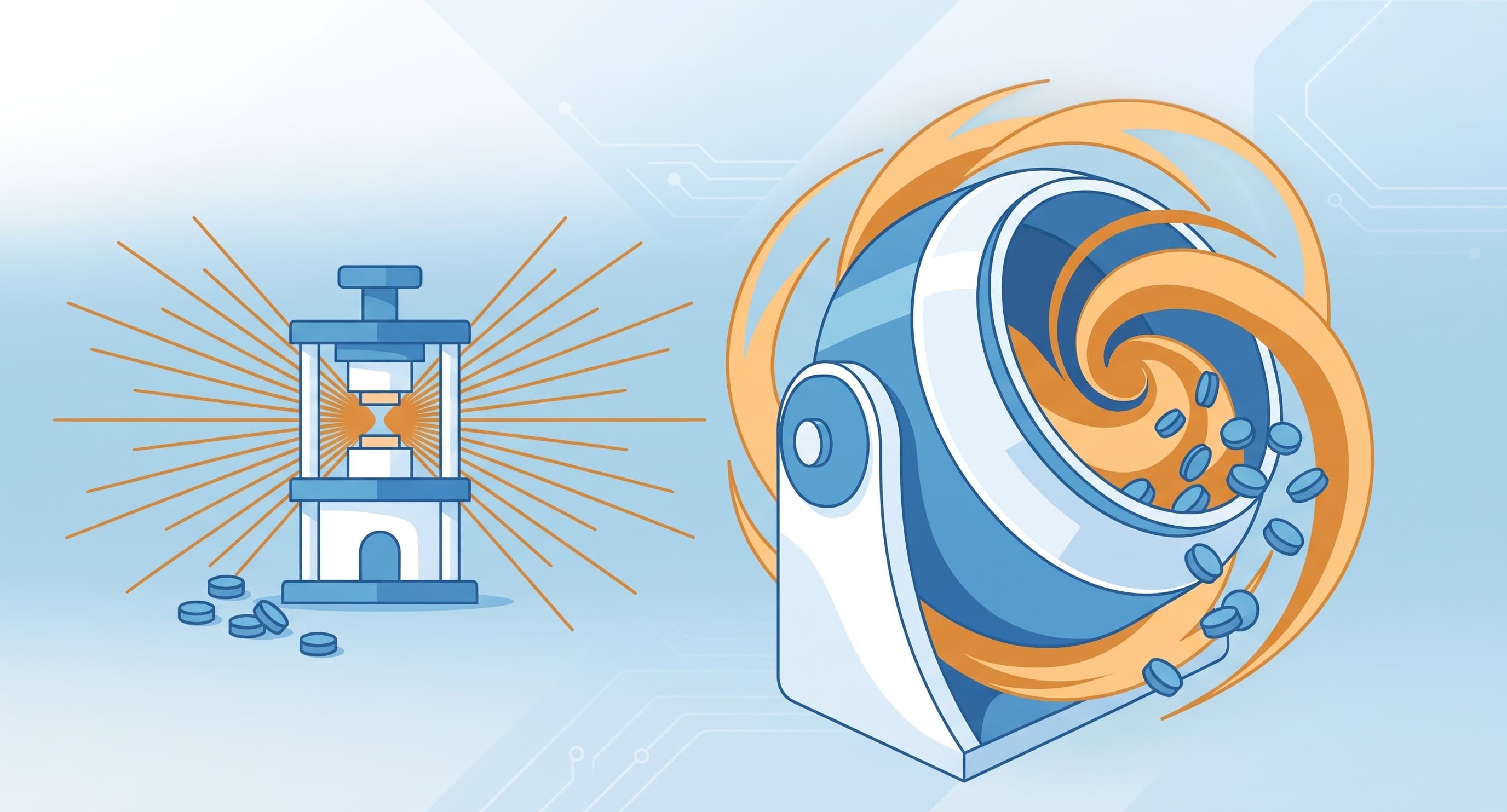
When Accord Healthcare -- the U.S. arm of India's Intas Pharmaceuticals -- filed to sell a generic version of the abuse-deterrent tablet, Purdue sued. Accord did not dispute that its manufacturing process matched the claim; it argued the claim should never have been granted, because using a coating pan instead of a tablet press was an obvious engineering choice, not an invention. A Delaware bench trial agreed in 2024, and on June 8, 2026, the Federal Circuit affirmed in full.
The court's reasoning turned on ordinary process engineering, not any new finding about oxycodone or PEO chemistry. Coating pans were already standard pharmaceutical equipment, already capable of processing hundreds of kilograms of tablets at once through convection heating -- hot air circulating through the drum -- rather than the tablet press's direct, conductive contact heat. The trial court credited testimony that a chemist trying to scale up Bartholomaus's process would have been especially drawn to a coating pan for exactly that reason: it let a manufacturer cure and coat tablets back to back, in equipment already sitting in the plant. Purdue's own argument -- that nobody had ever used a coating pan to cure anything before -- became the evidence against it: an unfamiliar use of a familiar machine, for its familiar heating function, in service of an already-obvious manufacturing problem, is not an invention.
There's a coda worth noting. The appellant that started this case was Purdue Pharma L.P., the company whose OxyContin marketing helped fuel the U.S. opioid crisis. Mid-appeal, Purdue's $7.4 billion bankruptcy settlement went effective. On May 1, 2026, the old company dissolved into Knoa Pharma LLC, a nonprofit built to sell addiction-treatment and overdose-reversal medicine at or below cost. Knoa inherited the '908 patent along with the rest of Purdue's intellectual property -- and, under its new name, lost the final fight over one of the molecules Purdue once fought hardest to protect.
What we do
See if this applies to one of your matters
We run genus/species (Markush) claim coverage analysis, Section 3(d) compliance screening, and prior-art structural triage on real chemical structures: not keyword search. If a case like this one is live for you, we'll run a free sample on a compound of your choosing.