
Semaglutide Export Ruling: Delhi High Court Balances Genus Patents and Global Generic Supply
By Prashant Kotian, PhD Researcher (Chemistry), ICT Mumbai
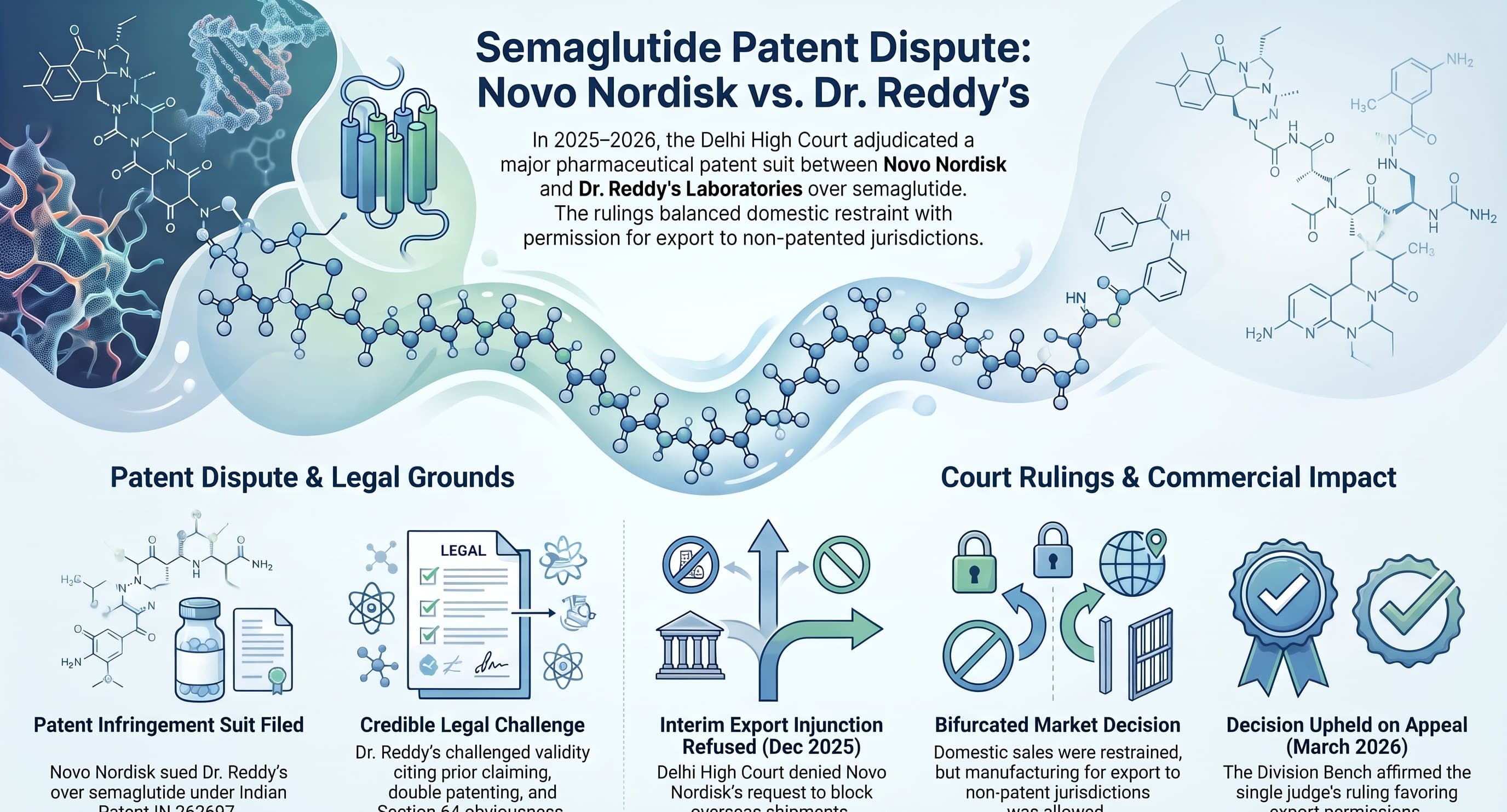
The Indian pharmaceutical patent landscape witnessed a defining moment in late 2025 and early 2026 as the Delhi High Court adjudicated a high-stakes dispute between Novo Nordisk A/S and Dr. Reddy's Laboratories Ltd. concerning semaglutide. The case, centered around Novo Nordisk's Indian Patent IN 262697 (expiring March 20, 2026), highlights the ongoing tension between enforcing broad Markush genus claims and facilitating the global supply of critical medicines.
Novo Nordisk filed an infringement suit (CS(COMM) 565/2025) seeking to enjoin Dr. Reddy's from importing, manufacturing, and exporting semaglutide--the active pharmaceutical ingredient in blockbuster GLP-1 receptor agonists like Ozempic and Wegovy. Dr. Reddy's mounted a robust defense, launching a "credible challenge" against the validity of the patent under Section 64 of the Patents Act, 1970. Their arguments hinged on prior claiming, double patenting, and obviousness, asserting that the specific species was anticipated or rendered obvious by prior broad genus disclosures.

On December 2, 2025, the Single Judge of the Delhi High Court delivered a nuanced ruling that denied Novo Nordisk's request for a blanket interim injunction. While Dr. Reddy's provided an undertaking to refrain from domestic sales within India, the Court permitted the generic manufacturer to continue manufacturing and exporting semaglutide to jurisdictions where Novo Nordisk does not hold corresponding patent rights. This decision underscored the Court's commitment to preventing the "evergreening" of patents while recognizing India's critical role as the "pharmacy of the world."
The Division Bench upheld this ruling in March 2026, solidifying the precedent. The decision serves as a crucial case study for chemistry-focused patent litigation. It demonstrates that broad Markush structures may face rigorous scrutiny for obviousness if a subsequent species patent does not demonstrate a significant, non-obvious technical advancement. For generic manufacturers, the ruling provides a clear legal pathway to leverage Indian manufacturing capabilities for export markets, even when domestic commercialization is blocked by an active, albeit contested, patent.
What we do
See if this applies to one of your matters
We run genus/species (Markush) claim coverage analysis, Section 3(d) compliance screening, and prior-art structural triage on real chemical structures: not keyword search. If a case like this one is live for you, we'll run a free sample on a compound of your choosing.